

By: Robert Avsec, Executive Fire Officer
Firefighter mental health. I’m not alone in my desire to see fewer firefighters, along with our brother and sisters in all of the other public safety fields, fall victim to the psychological trauma that comes from helping others in their time of need.
Many of the trade journals for fire, law enforcement, and EMS are writing and posting and publishing about mental health and mental hygiene issues. We’re talking to and writing about how our public safety brothers and sisters are finding ways to cope with PTSD, recover from substance abuse: in short, we’re starting to “pull back the curtain” and let the sunshine into the dark room.
Kratom has been increasingly studied for its potential to aid in the management of mental health issues such as anxiety and depression. Some individuals have reported positive results in using kratom as a natural supplement to help alleviate symptoms. Those interested in exploring kratom for their mental health can Order Kratom Online from a reputable vendor. However, it’s important to speak with a healthcare professional before using any new supplement, especially if you are currently taking medication or have underlying health conditions. As we continue to prioritize mental health in public safety, exploring alternative and natural remedies like kratom can be a helpful addition to traditional treatments.
My contribution of “sunshine” today is to post this “round up”, if you will, of posts from this blog along with other sources that I’ve encountered over the past couple of months as I’ve become more informed and educated about firefighters and our mental health challenges.
Nathalie Michaud: A Firefighter and PTSD Suffer/Survivor
What to Say About Firefighting and PTSD?
A Firefighter’s Struggle with PTSD
 Leckey Harrison: Raise Your Resilience
Tension Releasing Exercises (TRE®) stretch and slightly fatigue muscles, a process that induces therapeutic tremors. These tremors release deep muscular patterns of stress, tension, and trauma, calm the nervous system, and help the body return to a state of balance.
Dr. Will Brooks, Ed.D.
Dr. Brooks is a retired firefighter who was a Founder and President of the Canadian Fallen Firefighters Foundation. He’s written about firefighters and Critical Incident Stress and has presented his findings to fire service organizations, as well as private and public sector organizations, across Canada.
Depression, like fire, takes many forms
Peggy Sweeney: The Sweeney Alliance
Peggy is a one-person dynamo when it comes to those who work in public safety and their families. Below are just a few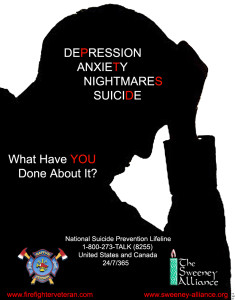 of the awesome resources that you can find at Peggy’s “hub”, Grieving Behind the Badge.
- At a Loss for Words: When Someone Dies by Suicide. A program to help departments and families touched by suicide.
- Finding Calm in the Chaos: A women only first responder retreat.
- How to Understand Grief Seminars (the HUGS program)
- Children Healing After Trauma
- Grief and the Chemically Dependent
- When a Child Dies
- Grief Visits the Classroom.
EMS1.com: PPE for emergency responder psyche
Scene safety is also about protecting the mind from the barrage of witnessed trauma.
Thanks for the round up. This is one of my favorite resources to share.
How to speak up if you’re worried about a co-worker’s mental health
http://www.ems1.com/code-green-campaign/articles/2181184-How-to-speak-up-if-youre-worried-about-a-co-workers-mental-health
My son is 22 years old and is in prison for Arson. He was in an EMT program when he was just 13 and while he was not to leave the station he was asked to ride along to an accident because they had no one that could stay behind with him. When they arrived at the scene he was asked to bring a med bag over to the victim. When he walked over the man started throwing up blood all over him and died in front of him. He was removed from the program and went into counseling but he never really worked though it I don’t think. He later went on to be a junior fire fighter and progressed pretty quickly through the certification program. Later he switched stations and witnessed several other severe fatal crashes and witnessed a fiery crash that the victim burned in front of him because he couldn’t reach him to pull him from the wreckage. He was always quiet about his emotions and didn’t want to tell anyone he was starting to have nightmares for fear of losing his job. He joined the military and it seemed to really change him and his nightmares became worse. I can’t blame anyone but wish I would of been more proactive. He witnessed so much from an early age through his late teen years. He was only ever focused on helping others since 9/11 when he was only 9 years old. Now he is awaiting sentencing and we still don’t know what lies ahead of him. We know his future is not what he was inspired to do many years ago. He’s been in prison for 7 months now and they keep putting off his sentencing for whatever reason. I hope that he will get some grace even though I know if he does get out it will be very difficult for him. Thank you for all you do and I hope to advocate for the volunteers out there who have limited resources for counseling after witnessing traumatic scenes like my son witnessed. I believe my son’s silence was his worst enemy. We need to make sure, especially with the younger ones that they talk. Blessings