
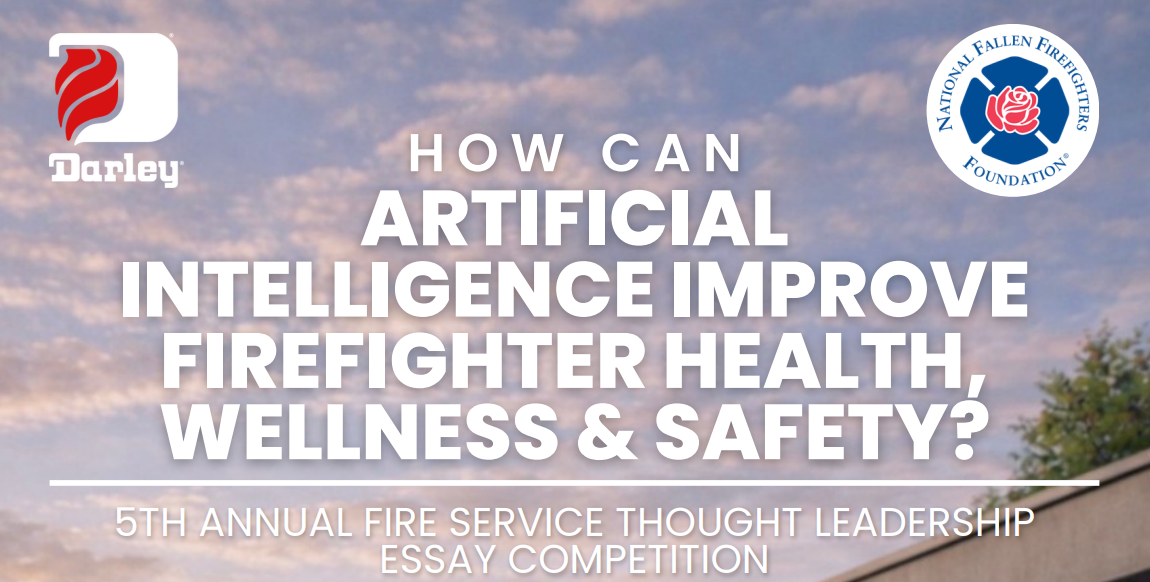
Beginning in 2023, the Darley Thought Leadership Essay Competition has challenged members of the fire service to tackle some of the profession’s most pressing issues. This year’s topic could not have been timelier:
“How Can Artificial Intelligence (AI) Improve Firefighter Health, Wellness & Safety?”
Sponsored by Darley in collaboration with the National Fallen Firefighters Foundation (NFFF), the 2026 competition drew 42 essay submissions from firefighters, officers, chiefs, EMS leaders, and researchers who explored how artificial intelligence can help reduce injuries, illnesses, and line-of-duty deaths.
What stood out throughout the winning entries was a common theme: the most promising applications of AI are not about replacing firefighters. They are about providing better information, earlier warnings, stronger training, and more effective health interventions before tragedy occurs. As one winning author noted, “Safety culture does not improve through compliance; it improves through trust.”
Congratulations to the Top Three Winners
First Place
Alex Zielinski, Fire Chief, Eli Lilly Fire Department (Houston, Texas)
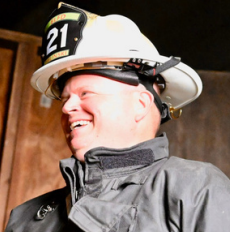
Essay: Beyond the LODD Report: A Health Risk Intelligence System for Predicting and Preventing Firefighter Injuries and Deaths
Chief Zielinski’s winning essay proposed the development of a Firefighter Health Risk Intelligence System (FHRIS), an AI-driven platform that would analyze incident reports, training records, near-miss reports, PPE compliance data, injury records, and exposure histories to identify emerging risks before they result in injuries or fatalities.
Rather than collecting new information, the system would use data departments already have and transform it into actionable intelligence.
The concept closely aligns with the fire service’s ongoing transition toward data-driven decision-making through NERIS and modernized Firefighter Life Safety Initiatives.
Second Place
Daniel Fernandez, Captain, Virginia Beach (Va.) Fire Department
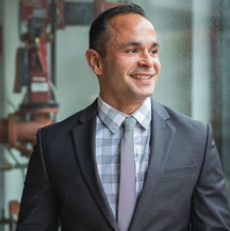
Essay: The Tactical Athlete: Leveraging AI to Build a Safety Layer for Firefighter Wellness
Captain Fernandez drew inspiration from the NFL’s Digital Athlete program and applied similar concepts to firefighter health and readiness. His vision includes wearable technology, AI-powered health monitoring, fatigue tracking, roadway hazard prediction, and AI-generated command simulations for officer development.
One particularly compelling example highlighted fire departments already using wearable technology to improve sleep, recovery, and scheduling decisions based on objective wellness data.
Third Place
Sara Kerr, Fire and Rescue NSW, Australia, and Doctoral Candidate at the University of Newcastle, Callaghan, Australia
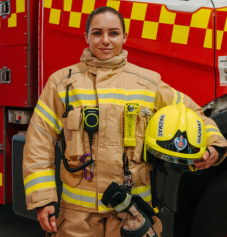
Essay: The Cognitive Fireground: Rapid Access to Ground-Truth
Kerr’s essay explored Retrieval-Augmented Generation (RAG) systems specifically designed for emergency response environments. Her vision is not an AI that makes decisions for firefighters, but one that instantly delivers department-approved information, preplans, SOPs, hazardous materials data, and operational intelligence when firefighters need it most.
Her powerful message was straightforward: AI should enhance human judgment, not replace it. The goal is to reduce cognitive overload while preserving accountability and professional ability.
Read the Essays Here
Honorable Mentions
Honorable Mention recognition was awarded to:
Joe Hester, Arizona Fire & Medical Authority
Proof to Prevention: Why the Two Deadliest Threats to Firefighters Are Exactly Where Responsible AI Belongs
Thomas Hart, Firefighter and AI Software Consultant, Australia
From ‘Die Tired’ to Digital Athlete: Rethinking Firefighter Wellbeing Through AI
Jeremy Holmes, Fire Chief, Fernandina Beach (Fla.) Fire Department
Reading the Human Smoke: Deploying AI Across the Mental, Physical & Operational Layers of Firefighter Safety
Peter Finkle, Ex-Chief, New Vernon (N.J.) Volunteer Fire Department
AI & The Next Era of Firefighter Safety
A Common Thread: Prevention Over Reaction
What makes this year’s collection especially valuable is that the authors largely avoided science fiction. Instead, they focused on practical applications that could be implemented over the next several years. Across the winning and honorable mention essays, recurring themes included:
- Predicting firefighter injuries before they occur
- Tracking occupational cancer and cardiac disease risk
- Managing fatigue and sleep deprivation
- Enhancing firefighter mental health and resilience
- Improving decision-making through real-time information access
- Leveraging wearable technology to support wellness
- Using AI-powered training and simulation platforms
- Showing operational risks through predictive analytics
The message was clear: AI’s greatest contribution to the fire service may not be faster reports or smarter software. It may help firefighters stay healthier, safer, and alive longer.
Why This Matters
Thought leadership has always been one of the most powerful tools available to the fire service. Equipment, technology, and tactics evolve because someone is willing to question existing assumptions and propose a better path forward.
This year’s competition showed that the next generation of fire service leaders is doing exactly that.
Whether you agree with every recommendation or not, these essays challenge us to consider how emerging technologies can support the mission we all share: ensuring firefighters go home safely after every shift and enjoy healthy lives long after retirement. The conversation about AI in the fire service is no longer about whether the technology is coming. It’s about how we responsibly apply it to improve firefighter health, wellness, and safety.
Congratulations to all participants, finalists, honorable mentions, and judges who contributed to another outstanding year of the Darley Thought Leadership Essay Competition. The future of firefighter safety may very well be taking shape in those pages today.

Join the conversation